For upside-down installation:
Our inertial sensors (Force-balance and MEMS) will work when mounted in an upside-down position with, except for slight changes in 0° offset (or bias in the case of an accelerometer), and changes in misalignment angles output and pendulous axes, resulting in some output error. In many use-cases, these errors can be ignored by the user, but in applications – where optimal accuracy is required – there is one option to consider:
- – Jewell can provide a customized version of the sensor, calibrated for upside down operation to eliminate the error caused by upside-down operations.
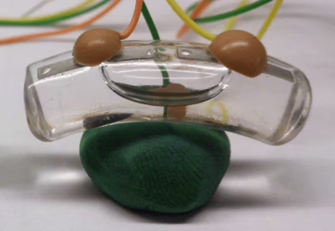
Our electrolytic products, on the other hand, will not work properly if mounted upside-down. These sensors consist of a vial partially filled with electrolytic conductive fluid in which – at level upright position – the enclosed bubble orients itself perpendicular to the gravity vector, causing a resistance change between the two excitation and pickup electrode on the bottom. This design acts as an extremely precise potentiometer. Because of the vial’s outward curvature and location of the electrodes, mounting them upside down would not allow the bubble to settle in the same position, nor yield similar results.
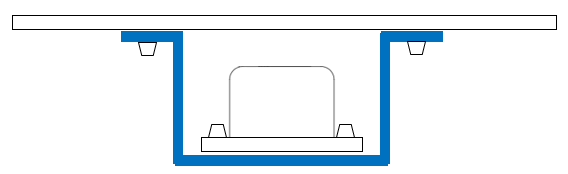
Workaround: Customers can install our tiltmeter on a C-shaped bracket underneath their structure, so the sensor itself is still mounted horizontally in upright position.
For vertical installation:
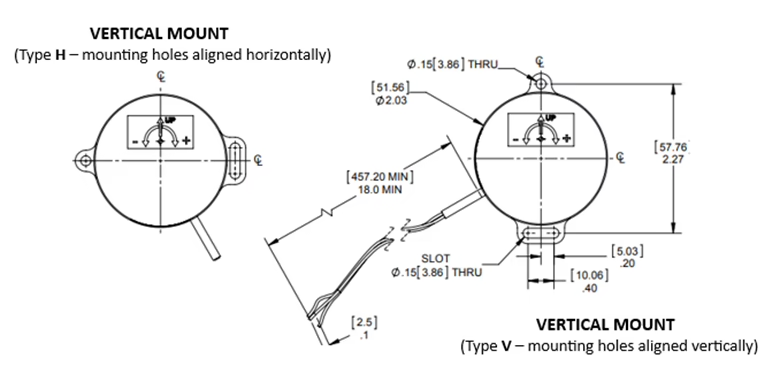
We currently offer some vertical-mount models such as our Force-balance RMIW inclinometer (-V & -H shown below), Electrolytic A716 tiltmeter and A902 slimline clinometer. Also, most of other electrolytic products already come with a vertical mounting bracket available as accessories for maximum flexibility. The Ruby MEMS accelerometer and inclinometers (JMHA, JMHI, JDHA and JDHI) also have this accessory available.
Standard inertial accelerometers (Force-balance and MEMS) mounted vertically can also operate well, with the exception that output reads 1g at rest due to gravity since the sensor is mounted with its sensitive axis aligned to vertical gravity vector. Customers can account for this by:
- – Purchasing a customized accelerometer with 1g bias which zeroes the accelerometer out at the nominal vertical position.
- – If necessary, customers can utilize an accelerometer with a range, at least 1g greater than they expect to measure, and normalize by subtracting 1G from the measurements to account for the static 1g reading.