For upside-down installation: Our inertial sensors (Force-balance and MEMS) will work when mounted in an upside-down position with, except for slight changes in 0° offset (or bias in the case of an accelerometer), and changes in misalignment angles output and pendulous axes, resulting in some output error. In many use-cases, these errors can be…
Continue ReadingAcceleration’s Effect on Inertial Inclinometers

Inertial sensors are often categorized as accelerometers and inclinometers. Fundamentally, they follow the same design and largely operate the same way however they differ in that an accelerometer’s output will correspond to dynamic, higher frequency input forces; compared to an inclinometer, where the output signal will reflect static to the measured environment expressed as a…
Continue ReadingeCompass Installation FAQ

What is the recommended minimum distance the eCompass products must be from any non-magnetic ferrous material to ensure their performance is not affected? Answer: It depends on the configuration of the ferrous material. You must be farther from a steel bridge or building than from a steel bolt or nut. Even if the ferrous material…
Continue ReadingJewell Signal Conditioners and Mini Tilt Sensors

While their name indicates a smaller size, our miniature tilt sensors still pack a punch when it comes to performance. Despite the dimensions, these sensors offer exceptional resolution down to 0.1µrad (<0.000006 deg) and are among our best-selling solutions for ultra-precision tilt measurements. Some are even vacuum compatible, such as our 755 & 756 (-VAC)…
Continue ReadingDifferences between the standard and “-R” version sensors
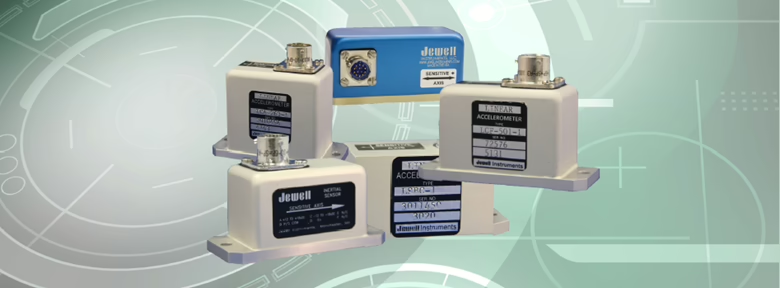
Jewell accelerometers and inclinometers are very rugged devices with exceptional performance, but what differentiates our models with “-R” (R meaning Rail) from the other sensors? There are 3 main differences that makes them ideal for Rail applications: The “-R” has a special filtered connector used to reduce radio frequency interference (RFI) and electromagnetic interference (EMI)…
Continue ReadingUnveiling the LCF-501-R!

The LCF-501 series of Force-balance accelerometers were developed as a transparent counterpart to the LCA-165, possessing the same range options, power requirements and form factor; additionally, the 501 series possesses improved performance due to the designs of the new standardized force-balance module: the J-301. This torquer type makes use of taut-band torsional suspension, rather than…
Continue ReadingHow to Minimize Temperature Errors in Tiltmeters

Many electrolytic sensors are placed in areas with extreme environmental conditions. These can be extreme cold when tracking a glacier or extreme heat when measuring the smallest vibration of a volcano. These temperature changes will alter the characteristics of your sensor as the metals expand and contract, ultimately affecting the output and accuracy of the…
Continue ReadingOvercoming Environmental Noise in Tilt Sensing Applications

Users of force balance inclinometers and tilt sensors can often see high noise in the field. Understanding the device is critical to solving the problem. A force balance inclinometer, or tilt sensor, is a high resolution, extremely accurate force balance accelerometer which is responding to the acceleration of Earth’s gravity to determine the angle of tilt….
Continue ReadingSensor Wiring & Connection Problems: SOLVED!

Many problems encountered when using sensors such as Jewell’s products are often a result of the way the sensors are connected. The wiring and connections of each product and model will vary, so it is very important to review the documentation for the specific model being used. It’s also important to make the distinction between…
Continue ReadingHow Unmanned Subsea Vehicles Use Electronic Compasses to Navigate

Whether you’re on a military mission, flying an airplane, or driving to your friend’s house, odds are you’ve used GPS. GPS has many uses, but not for underwater vehicles. For subsea navigation, an electronic compass is a key component for engineers. Limitations of GPS Beneath an open sky, low-end GPS systems such as smartphones are accurate…
Continue Reading